
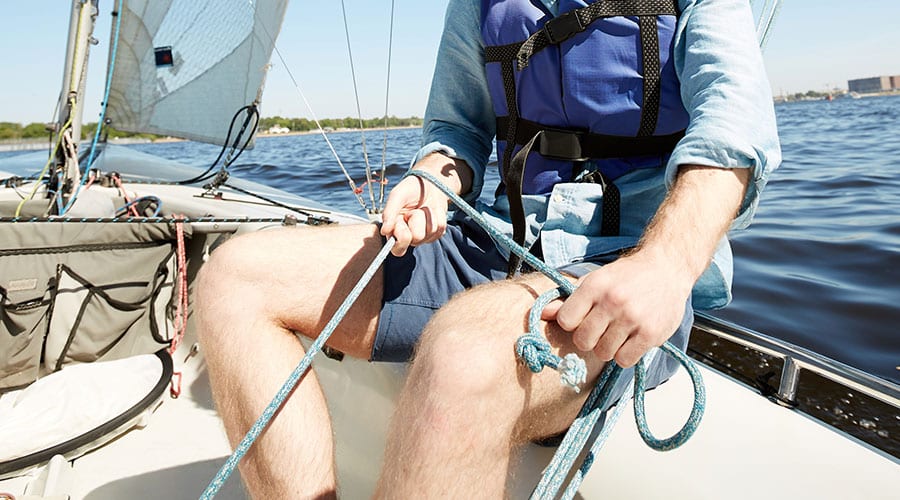
If you’re wondering about the name of that sailboat cable, then it’s worth your time to read this guide devoted to the names of ropes and cables.
Knowing basic sailing terminology is very useful, not only for those who do long regattas, but also for those who like to sail quietly with family and friends.
Aboard a sailboat, rope is the term that describes the material used to make the ropes, but each individual rope has a special name to describe the job it does:
- The vertical weave
The lines that support fixed objects, such as the mast, are usually constructed from steel cables and not ropes. They are called shrouds or stays. For example, the cable that runs from the mast to the bow of the boat is called the forestay.
- Mooring ropes
When you hear the instructor or skipper giving instructions to the crew as you prepare to moor alongside a dock or pier, spring lines are often used. It is a combination of lines that prevents movement at the bow and stern of a boat tied to a dock.
- Marching armament
Here fall all the movable lines that are used to pull up and/or adjust sails. For example, the line that goes up the mast to pull up the mainsail is called a halyard.
Each sail will have lines that control it while sailing. These are called sheets, and the name of the sheet refers to the sail it controls, for example, mainsail sheet or jib sheet. Unfortunately, there are exceptions. In fact, other lines used for sail adjustment are called Cunningham.
But let’s go in order and see the names of the sailboat lines and cables.
Names of sailboat lines and cables
Sailboat rigging can be divided into 2 major categories: sheets and halyards.
- Sheets
They are normally attached to the sail luff and control its shape and angle with respect to the wind; each individual sheet is identified by the sail name as a prefix, e.g. jib sheets, mainsail sheets, and so on.
- Halyards
They are attached to the sail head and used to hoist the sail onto the mast. In the same way as the sheets, each halyard is identified by the sail name as a prefix, e.g., main halyard.
Sheets and halyards are part of a more general category: that of current rigging.
Sailboat ropes: current maneuvers
Current rigging includes sheets, halyards and all other lines that contribute to the efficient management of a boat’s sail area. Specifically, these are used during navigation (running rigging) for mast and sail adjustment.
In addition to halyards and sheets, here are the other current maneuvers:
- Mainsail carriage or trasto is used as the wind increases to decrease the “heeling” effect of the mainsail without changing its shape;
- Jib trolley or sheet point;
- Vang or boom restraint;
- Cunningham adjusting mainsail luff tension.
- Tesabase that adjusts the tension of the mainsail base.
- Amantiglio that supports the boom during lowered sail stops.
Now that you are more familiar with the names of sailboat tops, all you have to do is sail to consolidate your knowledge of them and especially their use. Before you do, however, we invite you to visit our Boatsname.co.uk website to learn more about all the exclusive services that make your boat unique.
For us, quality, safety and customization are the most important ingredients, which is why we make energy-saving and state-of-the-art boat light systems.
Also on our site you can find highly durable stainless steel boat lettering that can be integrated with LED lights of different colors. Finally, another flagship product is our boat mats made from top-of-the-line materials and customizable.